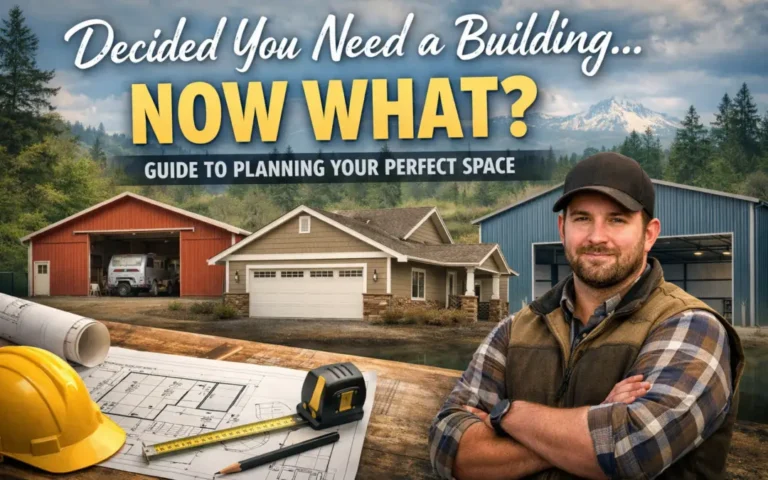
The decision has been made.
After constant trips to that storage unit—or the frustration of squeezing past everything in your crowded garage—you’ve decided it’s time to build.
Now what?
Where do you start? What kind of building fits you best? How big does it need to be? Will your city or county allow it? And where is the best location on your property?
These are questions I walk customers through all the time. No two situations are ever the same. Every property is different. Every budget is different. And every family uses their building a little differently.
If you’re the type of person who already has it dialed in, you probably don’t need this article. Grab a pencil, sketch it out, and call your contractor. We love a prepared client.
For everyone else, let’s walk through the main things I consider when meeting someone for the first time who needs guidance.
Real quick—there’s no way to cover everything in one article. This topic could easily turn into a chapter book if I let it. So I’m going to stick to the big-picture items that matter most.
1. What Is the Building Going to Be Used For?
This is always where I start.
I love building elaborate, top-notch structures. But if someone just wants to keep a lawn mower out of the weather and store a fishing boat, there’s no need to go over the top—especially if the budget is meant for something simple and functional.
On the other hand, if you have classic cars, want a hangout space for hosting friends, or plan to heat and cool the building year-round, you’ll likely want something more finished and more refined.
Your intended use drives almost every other decision.
Pole Buildings
For basic storage, a pole building is often the most efficient and economical solution. They’re strong, practical, and very versatile. For many homeowners, this is the best place to start.
That said, pole buildings can also be dressed up and finished out into impressive spaces—even full residential-style interiors if designed correctly.
Conventional Stick-Built Structures
If you’re planning to match your house, insulate to code, drywall, and possibly build out living space inside, a conventional stick-built structure may make more sense.
This is the same framing method most homes use. Studs are typically placed at 16” on center. Trusses are often spaced at 24” centers, which makes drywall installation straightforward. There aren’t large structural posts every 10–12 feet to work around for plumbing, ductwork, or layout.
Stick-built garages also make it simpler to match your home’s siding, roofing, and windows. When we build this way, we typically use 5-ply CDX plywood sheathing for strength and durability.
Could a pole building accomplish similar things? Yes. But sometimes it’s cleaner and simpler to start with conventional framing if the goal is to mirror your house.
Steel / Red Iron Buildings
Now let’s swing the other direction.
If you’re building a heavy-duty shop, planning industrial work, or need something capable of supporting equipment like overhead cranes, a steel structure might be the right solution.
We don’t build red iron steel buildings every week—but we absolutely have the capability. They’re not usually necessary for the average homeowner, but in certain situations they’re exactly what’s needed.
For most residential customers, the real decision usually comes down to pole building vs. stick-built garage.
Both can be simple. Both can be high-end. The key is choosing the right one for your needs.
2. How Big Is Big Enough?
I’ll keep this short.
Coming from someone who makes his living building, of course I’m going to say: go bigger.
But honestly, I’ve only had one client regret building bigger than they originally planned.
Here’s my unofficial formula:
The size you think you need × 1.5 = the size you’ll actually be happy with.
Most people outgrow their building faster than they expect.
3. What Factors Do You Have to Work Around?
Every property brings its own set of challenges. Some of the most common factors include:
- Soil type
- Accessibility to the building site
- HOA requirements
- Budget
- Drainage and water runoff
- Slopes or hills
- Wetlands
These aren’t small details. Sometimes they completely steer the direction of the project.
Accessibility
I once built a riding arena where the trusses needed to be 72 feet long. There was no way we were getting those into the site without some serious ingenuity.
In that case, a steel-framed structure made more sense because it arrived in pieces and we assembled it on-site.
Access alone can change the type of building that makes the most sense.
Soil Conditions
Soil type can also dictate design decisions.
With pole buildings, posts typically need to be set around 4’6” into native, undisturbed soil. But sometimes you hit hardpan—a dense soil layer that makes digging extremely difficult.
On one project, we encountered hardpan and had to engineer around the issue for several posts that couldn’t reach full depth. If you know your entire site has hardpan conditions, a conventional foundation might be the better route.
Building on a Hill
Building on a slope introduces its own complexity.
I’ve worked on projects where posts had to go into holes 2 feet wide and 12 feet deep. On one side of the building area we had standard depth, while the other side had 8 feet of fill. Some of those posts ended up over 36 feet long.
Had we built that project with a traditional stepped foundation, it would have added significant cost without improving the end result for the owner. A pole building gave them what they needed in a much more efficient way.
HOA Requirements & Matching Your Home
Sometimes the biggest factor isn’t engineering—it’s aesthetics.
If your building sits close to your home, you may want everything to flow together visually.
Pole buildings can absolutely be designed to resemble your home. But a trained eye can usually tell the difference. That may or may not matter to you.
As a contractor, I’ll push back if something doesn’t make sense structurally or financially. But at the end of the day, it’s your building.
If you want it pink, we’ll paint it pink.
So… What Kind of Building Do I Need?
Here are a few simple rules I tend to use:
- Basic storage, budget-conscious.
A simple pole building structure will likely meet your needs and leave money in your budget for what goes inside. - Insulated, tight storage for valuables.
If you’re insulating to code and protecting classic cars, furniture, or equipment, a stick-built garage often makes reaching that end goal simpler. - Large footprint with a section for entertainment or living space.
Pole buildings shine here. They efficiently cover large spans, and we can frame out portions conventionally inside. These are some of my favorite builds. - Conditioned space year-round + living area + must match the house.
Stick-built is usually the cleanest starting point if we’re matching your home and focusing heavily on air sealing and insulation. - Heavy-duty shop with overhead crane or industrial use.
Steel becomes part of the conversation.
It’s Your Building
At the end of the day, it’s your building.
It’s your hard-earned money (or debt). It’s your property. And it’s your decision.
Whether you hire us or another contractor, I encourage you to think ahead. Consider not only what you need today—but what you might want five or ten years from now.
There are decisions made in the planning stage that can save major headaches later.
For many families, spending $100,000–$300,000 on a building is one of the largest investments they’ll make in years. Take the time to evaluate your options. Do your research. And don’t let anyone push you in a direction you’re uncomfortable with.
If you want help thinking through your options, walking your property, or discussing what makes the most sense for your situation, we’re always happy to have that conversation.
— Taylor Zepp
Owner, Zepp Construction